Research case study
Political Alignment in Recommendations
Who contributes to improve a shared recommender?
- Online experiment
- Recommender systems
- Collective action

Research question
Who contributes to improve a shared recommender?
Steering a recommender towards a preferred balance requires user effort, but the resulting improvement is shared. The project asks when people contribute costly information and when they instead rely on a partner to improve the system.
Design
From private preferences to a shared system
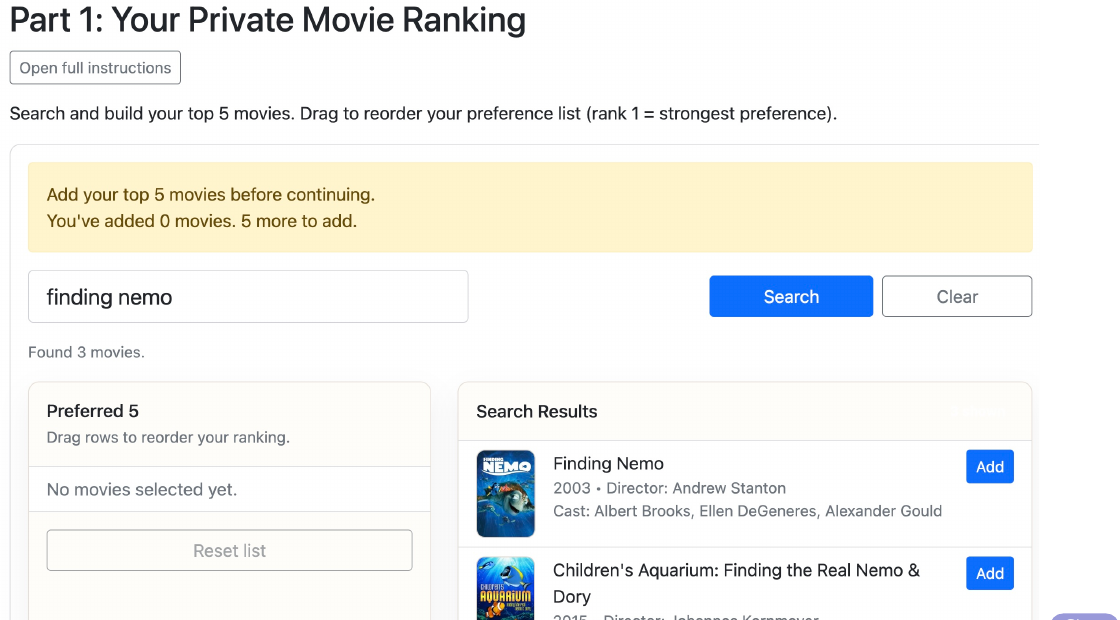
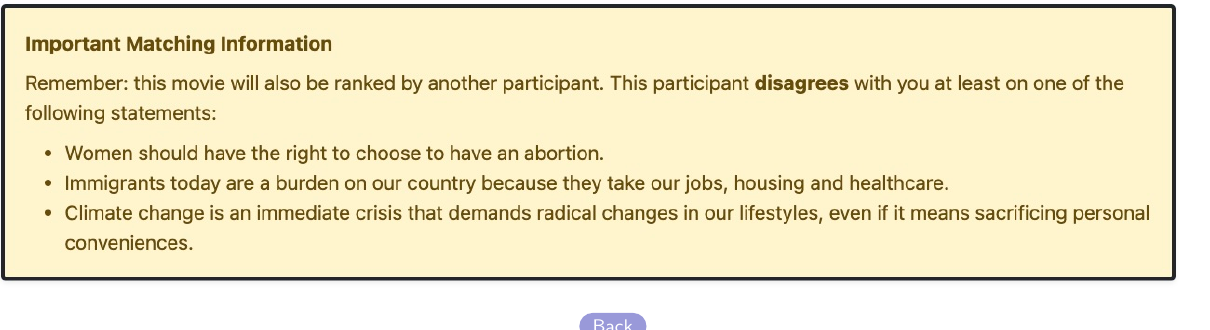
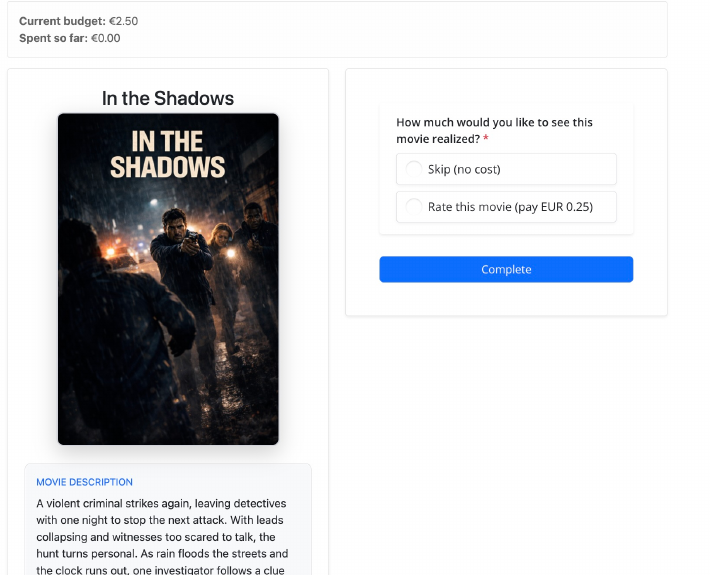
Participants establish a private movie ranking, are matched with another participant, and repeatedly decide whether to pay to provide a rating. A rating is privately costly but can improve recommendation quality for both people. The design crosses political versus non-political disagreement with homogeneous versus heterogeneous matches.
Participants create a private ranking that provides an accuracy benchmark.
The platform communicates whether a partner is similar or opposed in the relevant domain.
Each participant chooses whether to incur a private cost to add information.
Both matched participants can benefit from contributions to the recommender.
Interface evidence
The participant journey
The images document the implemented workflow without exposing a live participant-facing study.

Contribution
Research design made operational
I designed and implemented the platform and contributed to study design and piloting. The system combines preference elicitation, treatment-based matching, repeated incentivised decisions, and transparent payoff logic in a reusable experimental workflow.
Preliminary signal
Pilot evidence, not a final result
The pilot produced usable variation in contribution decisions. Interpretation remains preliminary while the team refines framing, beliefs, and the separation of strategic response from instruction-induced effects.
Outputs
Materials
Joint work with Dietmar Jannach, Silvia Milano, Caterina Giannetti, Cecilia Vergari, Nicola Meccheri, and Marco Catola.